Menifee Master Planned Communities, HOA Fees, and Amenities
July 2, 2026
July 2, 2026
If you are comparing neighborhoods in Menifee, the word master-planned can sound appealing and a little vague at the same time. You may be wondering what you actually get for the HOA dues, how much structure comes with the lifestyle, and whether the amenities will matter in your day-to-day life. This guide breaks down how Menifee master-planned communities work, what kinds of HOA amenities are common, and what to review before you buy. Let’s dive in.
Menifee has a long history of large planned neighborhoods. The city traces early development to Sun City in the 1960s and Menifee Lakes in 1989, and today many larger communities are guided by specific plans that set standards for land use, design, circulation, phasing, and infrastructure.
For you as a buyer, that usually means a more intentionally designed neighborhood with shared features and a more formal set of rules. In California, many of these communities are common-interest developments or planned developments, where ownership includes your home plus rights tied to common areas or facilities.
In many Menifee master-planned communities, HOA membership is automatic when you buy the home. The California Department of Real Estate explains that these communities often include HOA-owned or HOA-maintained common areas, and the governing rules typically stay attached to the property when it resells.
That is where CC&Rs come in. These recorded rules can affect things like exterior changes, parking, pet policies, rentals, and use of shared amenities, so it is important to understand them before you commit.
One of the biggest misconceptions about Menifee is that all master-planned neighborhoods offer the same experience. They do not.
Some communities are older and centered on golf or lake features. Others are newer and built around parks, trails, sports areas, and a broader mix of home styles. If you are shopping in Menifee, it helps to compare not just price and square footage, but also the age, layout, amenity style, and HOA structure of each community.
Menifee Lakes is one of the city’s older large master-planned areas and often serves as a local benchmark for lake-and-golf living. City materials describe it as a nearly 2,000-acre residential community built around a 45-acre artificial lake and golf course in 1989.
This is helpful if you are weighing established neighborhoods against newer construction. Menifee Lakes tends to represent a more mature community profile rather than a brand-new amenity package built around the latest clubhouse model.
Heritage Lake is a large residential master-planned community within the Menifee Valley Ranch Specific Plan area. City planning documents describe the broader plan as 1,548.3 acres, split between a northern community called Minor Ranch and a southern community called Heritage Lake.
Current neighborhood descriptions commonly note a 25-acre lake, clubhouse, pools, splash park, playgrounds, and walking trails. For many buyers, this is the kind of neighborhood that makes the HOA feel visible because the shared amenities are a central part of the community layout.
Audie Murphy Ranch is one of Menifee’s better-known newer specific plan communities. City and housing documents describe it as covering about 1,113 acres and including schools, recreational facilities, and open space.
The area also connects with public recreation features. City park listings identify Audie Murphy Ranch Sports Park as 11.29 acres, and the nearby skate park is currently Menifee’s only skate park.
Builder releases show that home options in Audie Murphy Ranch include newer single-family layouts with a range of sizes. Examples cited in the research include floor plans from about 1,698 to 2,697 square feet in one neighborhood and roughly 2,718 to 3,492 square feet in another.
If you want newer construction with planned recreation nearby, this community often enters the conversation. Still, the right fit depends on how much you value those features compared with dues, taxes, and rules.
Menifee Valley offers a slightly different example of newer planning in the city. The specific plan describes a 590.3-acre project with single-family and multi-family homes, a school site, a public sports park, preserved open space, walking trails, and a greenbelt connection toward Heritage Lake through a planned pedestrian bridge.
For buyers, this is a reminder that newer master-planned communities may include more housing variety than older golf- or lake-oriented neighborhoods. If flexibility matters, this type of plan may be worth a closer look.
Recent Menifee projects continue the same broad pattern of planned amenities. Shadow Mountain has been described in builder materials as a new single-family community with planned parks, a playground, soccer field, basketball court, and walking, biking, and hiking trails.
Nautical Cove has been described with future amenities such as a 10-acre lake, community center, pool and spa, sports courts, park, and walking paths. These examples show how amenity packages can differ widely even within the same city.
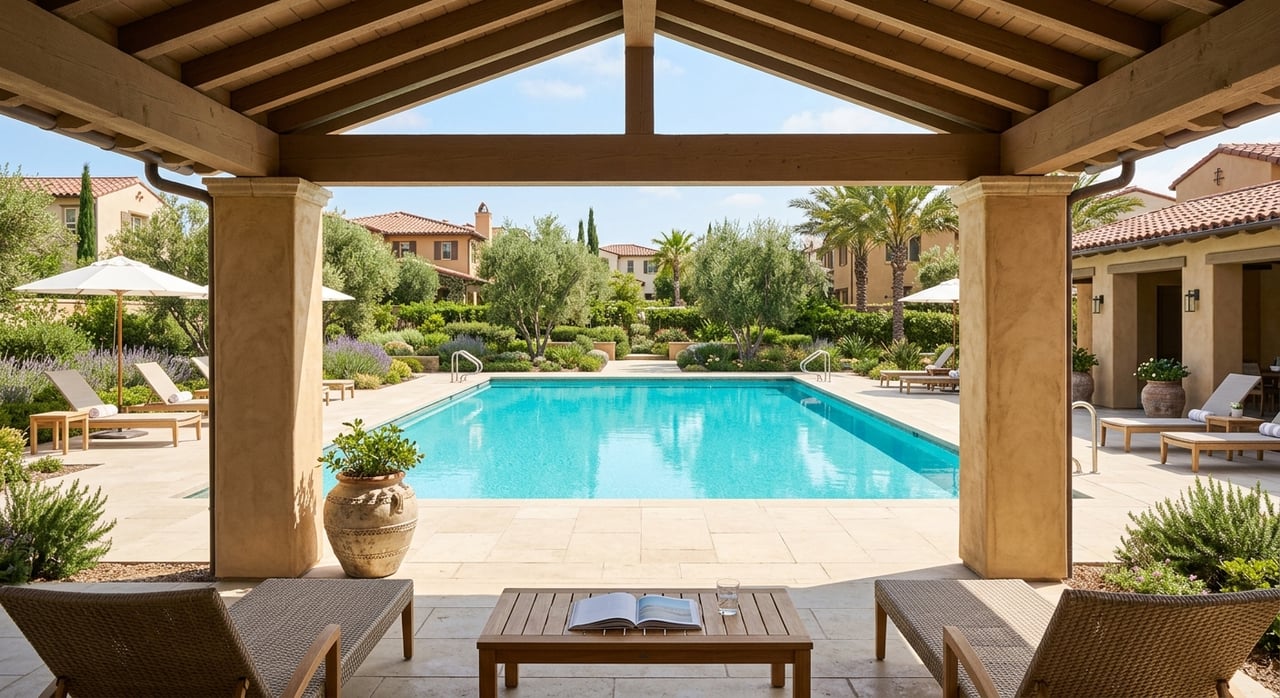
Across Menifee’s planned communities, the most common amenity categories tend to include:
That sounds simple, but there is an important detail. Not every attractive feature you see inside a community is necessarily owned or maintained by the HOA.
In Menifee, private and public amenities can overlap. City parks such as Audie Murphy Ranch Sports Park, Heritage Lake Sports Park, and Quartz Ranch Park are located within or adjacent to planned neighborhoods, which can make it easy to assume everything is part of the HOA.
Before you buy, confirm whether an amenity is HOA-owned, city-owned, or shared in some way. That distinction can affect access, maintenance responsibility, guest rules, and how much of your dues are really supporting the features you care about most.
A beautiful pool or trail system should never be the only reason you choose a community. The paperwork matters just as much.
In California, sellers are required to provide governing documents before transfer. You should carefully review:
California Civil Code also states that operating rules cannot conflict with governing law or with the declaration, articles, or bylaws. That is one reason a full document review is so important.
Monthly dues only tell part of the story. You should also look at reserves and whether the HOA appears to be planning responsibly for future repair and replacement costs.
California requires reserve study inspections at least every three years for associations that meet the statutory threshold. The reserve funding plan must also include the timing and amount of assessment changes needed to fund reserves.
California law places limits on how much regular assessments can generally be increased in a fiscal year without member approval. Regular assessments generally cannot increase by more than 20% in a fiscal year, and special assessments generally cannot exceed 5% of budgeted gross expenses without member approval.
That does not mean costs never rise. It means you should read the budget and reserve information closely so you have a clearer picture of how the association is managing long-term obligations.
In Menifee, HOA dues may not be the only ongoing community-related cost. The city’s CFD and CIP information shows that some master-planned areas, including Audie Murphy Ranch and Heritage Lake, are tied to community facilities districts.
That is why I always encourage buyers to ask one simple question early: besides the mortgage, taxes, and insurance, what recurring community costs apply to this property? Getting that answer upfront can prevent surprises later.
If you are trying to choose between a master-planned community and a more traditional neighborhood in Menifee, focus on the tradeoffs that will actually affect your life. A strong comparison usually comes down to use, rules, and total cost.
Ask yourself:
In Menifee, the choice is often between newer communities with bundled recreation and more structured HOA control, or older neighborhoods with a different feel, different lot patterns, and a different cost structure.
On paper, two Menifee homes can look very similar. In practice, they can come with very different HOA rules, reserve health, amenity access, and community costs.
That is where experienced local guidance matters. When you are comparing neighborhoods, reviewing HOA documents, and looking at the full monthly and annual cost picture, having someone who understands both the lifestyle side and the transaction details can make the process much less stressful.
If you are exploring Menifee master-planned communities or trying to make sense of HOA documents before you buy, Sabrina Maricic can help you compare your options with clear, practical guidance.
Whether you are buying your first home or selling an investment, Sabrina brings clarity to the complex real estate process. She is known for her approachable nature and fierce commitment to getting the best results for her clients. Connect with her today for a seamless experience.